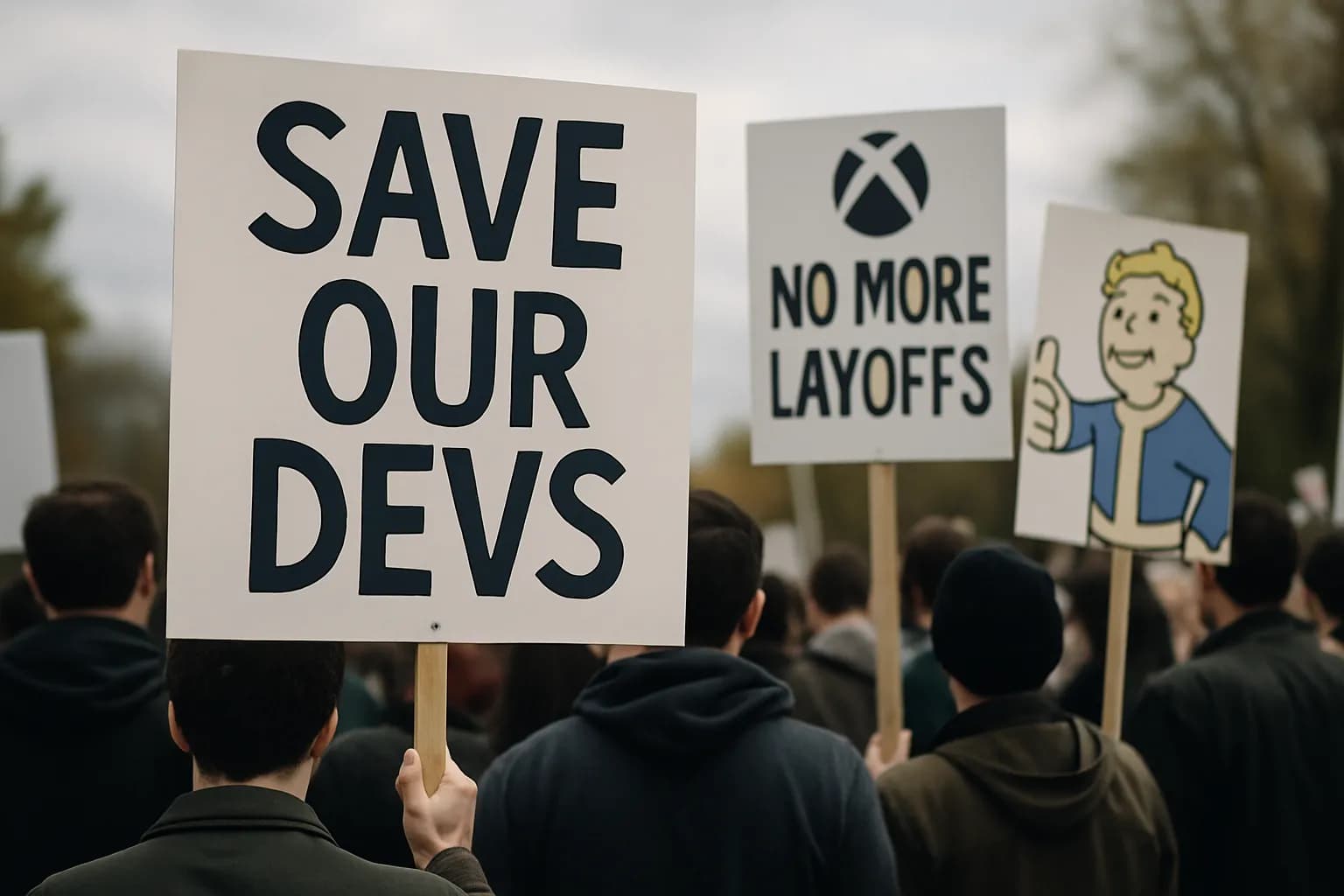
On July 15, unionised Microsoft workers walked out of five studios at the same time. Inside Fallout 4, modders filled the Commonwealth with the exact same protest signs. Here is what the "Save Our Devs" march is about, what the union is actually demanding, and why the fallout from Xbox's 3,200 job cuts is likely to reach the games you play.
What Microsoft announced on July 6
Microsoft confirmed 4,800 job cuts — around 2.1% of its global workforce. Of those, 3,200 land on Xbox, which works out to roughly 20% of the Xbox division over the coming year. It is the largest single reduction the gaming arm has seen in a run of cuts stretching back to 2023.
Alongside the layoffs, four studios are leaving Microsoft entirely:
- Compulsion Games and Double Fine Productions return to their own management as independent studios, keeping their IP, catalogue and runway for their next projects.
- Ninja Theory and Undead Labs have agreed terms with new owners, with funding attached to finish and grow Senua and State of Decay 3.
The official framing is a refocus on Microsoft's biggest franchises — Fallout, The Elder Scrolls, Call of Duty, Halo. The objection from workers is that the refocus is being paid for by the people who built those franchises in the first place.
This is not an isolated quarter, either. Studio closures and restructures have been the industry's baseline for two years now — see IO Interactive regaining Project Fantasy while closing its Istanbul studio — and the hardware market is contracting in parallel, with console shipments forecast to fall 19.5% to 33.9M units in 2026.
The 440 that triggered the march
Of the 3,200 Xbox roles, 440 were union-represented. They were spread across:
- Bethesda Game Studios
- ZeniMax Online Studios
- id Software
- ZeniMax Workers United (QA)
- ZeniMax corporate
That detail is what turned this round of layoffs into an organised response rather than a news cycle. OneBGS — the CWA-affiliated union representing more than 240 Bethesda Game Studios employees — called a march, and it landed on July 15.
"Save Our Devs": the rallies
The "Save Our Devs" march ran at 12:30 PM ET on July 15, simultaneously across four studio locations:
| Location | Studio presence | |---|---| | Rockville, Maryland | Bethesda Game Studios HQ | | Austin, Texas | ZeniMax Online Studios | | Dallas, Texas | id Software | | Montreal, Canada | ZeniMax operations |
Separately, United Videogame Workers-CWA held its own rally at noon at Microsoft's Redmond campus in Washington — putting a picket line at the corporate front door on the same day as the studio marches.
What the union is actually demanding
This is the part that gets flattened in most coverage. The demands are narrow, legal and specific. Because the affected roles are unionised, Microsoft is legally obliged to engage in "effects bargaining" — negotiating how the layoffs are carried out, even if the decision itself stands.
CWA District Vice President Mike Davis set out four asks:
1. Fair severance, bargained rather than imposed. 2. A say in vendor-contract decisions — i.e. work being handed to outside contractors. 3. Internal placement, so qualified staff can move into open roles elsewhere at Microsoft instead of out the door. 4. Recall rights, giving laid-off workers first claim on their jobs if the roles come back.
Nobody is asking Microsoft to un-announce the cuts. They are asking Microsoft to come to the table — and the union's position is that the company has been stalling.
The id Software problem
A report drawing on testimony from affected staff describes an environment of secrecy, disarray and fear inside the division. One line does most of the damage:
"The institutional knowledge that has been lost or will be lost completely as individuals leave the gaming industry all together is staggering."
The specifics are worse than the mood. According to that testimony, roughly 90% of the id Software design team overseeing AI and gameplay was laid off — including "employee number 13," one of the longest-serving people at the studio, there since its formative years.
id Tech is not documentation you can hand to a new hire. It is decades of accumulated engine knowledge held by a small number of people, and the DOOM franchise runs on it. Cutting the AI and gameplay design team while telling the market you are doubling down on flagship franchises is, at minimum, a strange sequencing decision.
Fallout 4 modders joined the picket line
Here is the part that made this story travel beyond the trade press.
Modders Elianora and greenFoxel released Fallout 4 mods that drop the protest directly into the game world. Two are live on Nexus Mods — "One for All and All for One – Support the Devs" and "Unified Front – Save Our Devs."
They add:
- Pro-union signage across the Commonwealth, with slogans lifted straight from the march: "Save the Devs, Stop the layoffs!" and "Stand United. Don't mourn, organise!"
- T-shirts, jackets and power armour carrying union branding.
- A Pip-Boy skin and vault suits emblazoned with the OneBGS logo.
The symbolism is hard to miss. Bethesda's own vault suit — the single most recognisable asset the studio owns — re-skinned by volunteers as a union uniform, inside the game whose sequel the layoffs are supposedly protecting. Microsoft says it is refocusing on Fallout. The Fallout community answered by turning Fallout into a protest sign.
Why this matters if you just want to play games
It is tempting to file layoffs under "business news" and move on. Three reasons not to:
Franchise quality is downstream of retention. When the people who know how an engine handles AI and gameplay leave, that knowledge does not transfer via handover doc. It shows up years later as delays, or as a sequel that feels off in ways nobody can quite name.
Independence is not automatically a downgrade. Compulsion and Double Fine walking away with their IP and runway is a genuinely better outcome than a shutdown. Ninja Theory and Undead Labs having funding tied to finishing Senua and State of Decay 3 means those games still exist. The spin-offs are the least bad part of this.
Effects bargaining sets a precedent. If a union of 240 people can win recall rights and internal placement from Microsoft, that becomes the template every other studio union points to. If Microsoft stalls it out successfully, that is also a template.
The industry is restructuring on every axis at once — staffing, hardware, and distribution, with Sony ending PlayStation disc production in January 2028 as its own marker of the same shift. July 15 is one visible day in a much longer process.
What happens next
Watch for whether Microsoft actually opens effects bargaining or continues to run out the clock. Watch whether the July 15 turnout gives OneBGS the leverage to pull other Xbox studios into organising. And watch id Software's next output, because that is where the institutional-knowledge bill eventually comes due.
Meanwhile, the mods are still up, and the Commonwealth is still covered in protest signs.
---
Sources: Rock Paper Shotgun · Eurogamer · Game Developer · CNBC · Nexus Mods
More industry coverage in our News section.