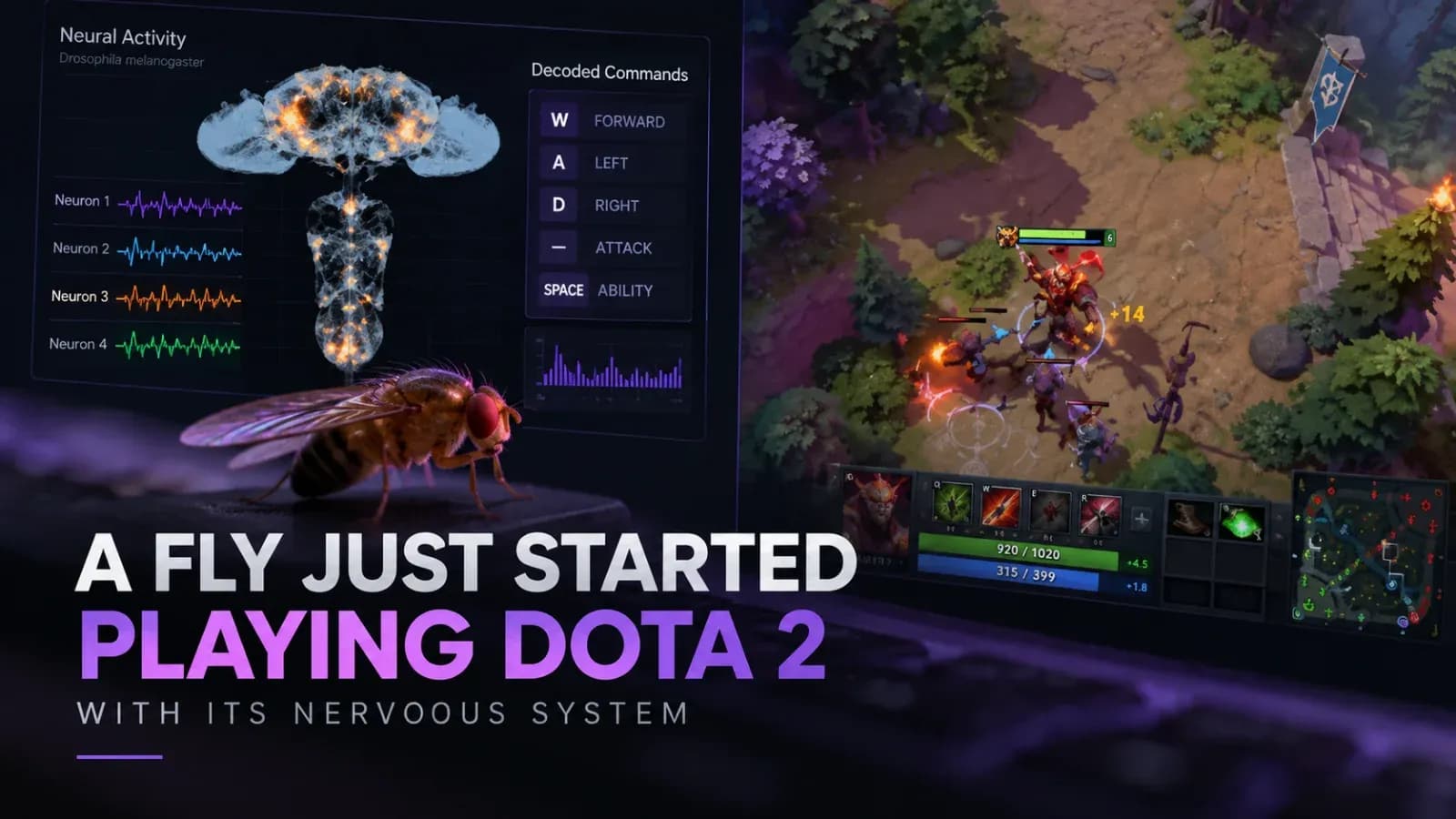
A Fly Just Started Playing Dota 2 With Its Nervous System
This sounds like a shitpost.
A fly. A keyboard. A live Dota 2 match. Neural activity moving across the screen while inputs are being triggered underneath it.
No hands on the keyboard. No player sitting at the desk. Just an insect nervous system apparently producing commands that end up inside a videogame.
And somehow, in 2026, that sentence does not sound completely impossible anymore.
Footage circulating online appears to show exactly that kind of experiment: neural activity on one side, a game on the other, and biological signals being translated into digital controls.
At first glance, the conclusion seems obvious.
Someone connected a fly to a computer and made it play a videogame.
Which immediately raises two questions.
First: how the hell would that even work?
Second: have you ever actually confirmed that the carry on the opposite side of your Dota match is human?
We have spent years blaming bad teammates on matchmaking. Maybe we should have been asking whether they have a ventral nerve cord.
The footage looks insane — but there is an important catch
Before we declare that fruit flies have officially entered the Dota 2 matchmaking pool, there is an important distinction to make.
The viral description presents the setup as if a living fly is sitting there while its complete neural activity is captured in real time and directly translated into keyboard commands during the game.
That exact version of the story is difficult to verify from a primary scientific source.
The numbers circulating with the footage — including claims about 120,328 annotated neurons and 20,417 linked axons — also do not line up cleanly with the major published complete Drosophila connectome datasets.
There is another obvious clue for anyone who plays games: some versions of the interface show commands such as FORWARD, LEFT, RIGHT, JUMP and PRIMARY FIRE.
Dota 2 players may notice one small problem.
We don't exactly spend our pubs pressing a dedicated JUMP button.
So we should not present the viral footage as proof that scientists literally plugged a living fly into Dota 2 matchmaking and watched it start laning.
But don't close the tab yet.
Because the real science underneath this story is arguably crazier than the meme.
Scientists have actually mapped the brain of a fruit fly
To understand how anything resembling this experiment can work, you first need to understand one word:
connectome.
A connectome is basically a wiring map of a nervous system.
Your brain is made of neurons. Those neurons communicate with other neurons through connections called synapses. The important part isn't simply knowing that the neurons exist — it is knowing which neurons connect to which other neurons.
Imagine opening an insanely complicated electrical diagram.
One component connects here.
Another connects there.
A signal can travel through one pathway and eventually influence something somewhere else.
A nervous system is obviously far more complicated than a motherboard, but the analogy is useful: researchers are trying to reconstruct the biological wiring behind behavior.
And with fruit flies, they have reached an astonishing level of detail.
139,255 neurons and roughly 54.5 million synapses
In 2024, researchers working with the FlyWire project published a reconstruction of the brain of an adult female fruit fly, Drosophila melanogaster.
The dataset contained 139,255 neurons and approximately 54.5 million synapses.
Not estimates represented by a cartoon brain.
An enormous reconstructed network showing how individual neurons connect across the fly brain.
The work was published in Nature and became a major milestone in connectomics.
You can read the research here.
But mapping the brain alone still leaves a major question.
A brain can process information.
How does that information eventually become movement?
That's where things get especially relevant to the idea of controlling a game.
Then scientists mapped the fly's central nervous system
In 2026, researchers published a complete connectome of the central nervous system of an adult male fruit fly.
This dataset went beyond the brain.
It included both the brain and the ventral nerve cord, covering roughly 166,700 neurons.
The research was published in Cell and gives scientists a way to study neural pathways extending much closer to the systems responsible for actual movement and behavior.
You can find the publication here.
And the ventral nerve cord is where our Dota story starts becoming much easier to understand.
What the hell is a ventral nerve cord?
If you are not a neuroscientist, the easiest way to think about it is as something that performs some of the roles you might loosely associate with a spinal cord.
It is not literally the same thing as a human spinal cord.
But insects use the ventral nerve cord, or VNC, as a major part of the communication and control system between the brain and body.
Neural circuits associated with movement run through this system.
Walking.
Turning.
Moving legs.
Controlling wings.
Responding to threats.
Coordinating different motor behaviors.
So once researchers can map both the brain and these motor-related circuits, they can begin following something extremely important:
How does information inside a nervous system eventually become an action?
And that is how a fly can theoretically "press" a keyboard key
Here's the simple version.
Imagine that a particular pattern of activity inside a neural model is associated with forward movement.
Normally, inside an actual animal, neural activity would ultimately contribute to the activation of muscles.
Legs move.
The fly moves forward.
But if the nervous system — or a computational model based on its wiring — is connected to software, there is no rule saying that the output has to end at a biological muscle.
You can create another translation layer.
The software sees a particular motor-related output and says:
Okay. That means W.
Another pattern appears.
That means turn left.
Another output.
That means turn right.
Once you understand that translation layer, the whole "fly controlling a game" concept becomes much less magical.
The nervous system doesn't need to know what a keyboard is.
It doesn't physically need to press W.
The computer simply takes one type of signal and maps it onto another type of command.
The fly does not know it is playing Dota 2
This is probably the most important distinction in the entire story.
Making a hero move because of activity generated by an insect nervous system is not the same thing as teaching a fly Dota.
The fly does not suddenly understand that there are three lanes.
It doesn't know what Roshan is.
It doesn't know why your position 5 is begging everyone to buy detection.
It isn't calculating whether the enemy carry is going to hit a timing before your team.
And it probably isn't intentionally griefing your MMR.
Probably.
What the system can do is create a mapping between neural activity and digital actions.
If one signal becomes "move forward," then movement inside the game can appear whenever that signal is produced.
That can look like the nervous system is controlling the game — because, at the input level, it actually is influencing what happens on screen.
But control is not the same thing as understanding.
Think of it like connecting a sensor to a light
Imagine connecting a temperature sensor to a lamp.
When the temperature reaches 30 degrees, the lamp turns on.
The sensor has now caused something to happen in the room.
But the sensor does not understand lamps.
It does not understand rooms.
It doesn't have an opinion about whether the lighting looks good.
You simply created a rule connecting one signal to another action.
A nervous system is incomparably more complicated, but this basic concept helps explain why biological neural activity can be converted into completely artificial commands.
The interesting part is not that the fly somehow understands a keyboard.
The interesting part is that computers are becoming capable of sitting between biology and software and translating one into the other.
And the fly doesn't necessarily have to be physically sitting there
This is where the story gets even stranger.
Once researchers reconstruct a connectome, the network exists as data.
They know which reconstructed neurons connect to other reconstructed neurons.
That does not mean they have created a perfect digital copy of the animal.
This distinction matters.
A connectome is an incredibly detailed wiring diagram, but a biological nervous system is much more than static wiring.
Real neurons have electrical properties.
Synapses change.
Chemicals modulate activity.
The body constantly sends sensory information back into the nervous system.
Past activity can affect future activity.
Biology is messy.
So downloading a connectome does not mean you have downloaded the fly's consciousness.
What researchers and developers can do, however, is place computational neuron models onto biological connectivity data.
Then they can stimulate that network and observe how activity moves through it.
Which gives us something that would have sounded ridiculous not very long ago:
A computer simulation whose architecture comes from the real nervous system of an animal.
From nervous system to virtual body
There is already serious research exploring the relationship between fly neural circuits and simulated behavior.
Projects such as NeuroMechFly use biomechanical models of Drosophila to study how neural control could produce movement in a simulated body.
This matters because mapping neurons is only half the problem.
Eventually, scientists want to understand what those neurons actually do.
If a particular circuit becomes active, does the fly turn?
Does it walk?
Does it change direction?
Does it react to something it sees?
A virtual body gives researchers an environment in which those questions can be tested computationally.
And once you already have a digital output controlling a virtual body, connecting that output to some other virtual environment is conceptually not such an enormous leap.
Why videogames are perfect for weird experiments like this
Games are already giant input-output machines.
They accept commands.
Move forward.
Move backward.
Turn.
Attack.
Use an ability.
Move a cursor.
And then the game immediately shows you what happened.
From the game's perspective, it doesn't necessarily matter where the command originated.
A human can press a key.
A script can generate an input.
An AI agent can select an action.
A brain-computer interface can decode a signal.
A simulated biological neural network can produce an output.
At the final layer, the game simply receives a command.
That's why videogames make such interesting environments for experiments involving unconventional controllers.
Now ask the uncomfortable question: isn't this getting a little terrifying?
The Dota part is funny.
The underlying technological direction is harder to laugh off.
We are mapping nervous systems at increasingly ridiculous levels of detail.
We are learning how sensory information travels through biological neural networks.
We are identifying circuits involved in motor behavior.
We are building computational models based on biological connectivity.
We are getting better at decoding neural signals.
And we already know how to translate signals from nervous systems into commands for machines.
None of this means Skynet is going to wake up tomorrow because somebody simulated a fruit fly.
It also doesn't mean scientists have "solved" the brain.
They haven't.
But stop for a second and consider how insane the current situation would sound to someone a few decades ago.
We can reconstruct hundreds of thousands of individual neurons from an animal nervous system, map tens of millions of connections, put the resulting structure inside a computer and use that data to investigate how biological circuits produce behavior.
That is no longer science fiction.
139,255 neurons became roughly 166,700 across a larger system
The interesting part is not simply that the numbers keep getting larger.
The 2024 FlyWire brain reconstruction gave researchers a detailed map of 139,255 neurons and around 54.5 million synapses in an adult female fly brain.
The 2026 male connectome expanded the scope to the central nervous system, including the brain and ventral nerve cord, with roughly 166,700 neurons.
Adding the nerve cord is especially important because it helps researchers connect two worlds:
information processing and physical behavior.
A nervous system receives information.
Something happens inside its network.
Eventually the animal does something.
Walks.
Turns.
Escapes.
Flies.
If we can increasingly understand the pathways between those stages, we gain a much better understanding of how biological systems turn information into action.
Does this mean we're close to simulating a human brain?
No.
Not even remotely at this level.
This is where the scale becomes important.
A fruit fly nervous system contains on the order of hundreds of thousands of neurons.
The human brain contains roughly tens of billions.
And simply comparing neuron counts actually understates the problem.
To understand a brain in extreme detail, researchers need information about enormous numbers of connections between those neurons.
Then comes another problem: knowing that two neurons connect does not automatically tell you everything about how that connection behaves.
Then comes another problem: the brain is connected to a living body.
Then sensory feedback.
Then chemistry.
Then learning.
Then memory.
Then everything we still don't properly understand about consciousness.
So no, humanity is not one Drosophila connectome away from uploading people into Steam.
But flies provide a system small enough that scientists can attempt experiments that would currently be completely unrealistic at human scale.
AI makes the whole thing even more interesting
There is a reason neuroscience and modern computing are becoming increasingly intertwined.
Mapping nervous systems produces absurd amounts of data.
Researchers use electron microscopy to capture incredibly detailed images of biological tissue. Reconstructing neurons through enormous image datasets is a massive computational challenge.
Automated methods can help identify and segment neural structures, while researchers and large collaborative projects verify, annotate and analyze the resulting networks.
That creates a strange loop.
Better computing helps us map brains.
Better brain maps give us better biological data.
That biological data helps us understand how natural neural systems process information.
And those discoveries can then influence new computational models.
Biology studies computation.
Computation studies biology.
And somewhere in the middle, somebody inevitably asks whether it can run Dota.
Brain-computer interfaces make the joke feel less impossible
There is another reason the viral footage feels believable.
Humans are already building interfaces that translate neural activity into machine commands.
The general concept of a brain-computer interface is not science fiction.
Researchers have demonstrated systems in which neural signals can be decoded to help control cursors, communication interfaces and other external devices.
The exact techniques vary enormously depending on the experiment, species, recording method and goal.
But the fundamental idea is established:
Biological neural activity can contain enough information for a computer to extract a useful control signal.
Once you know that, the idea of converting neural activity into a keyboard command stops sounding supernatural.
The difficult part is determining what the signal means, recording it reliably and translating it into useful behavior.
So could an actual fly eventually play Dota?
Depends entirely on what we mean by "play."
Could neural activity ultimately be mapped onto commands that cause something to move inside a videogame?
Yes, that concept is plausible.
Could a fly understand Dota 2 as a competitive strategy game, recognize heroes, understand item builds, manage lane equilibrium, coordinate with teammates and deliberately destroy the enemy Ancient?
There is absolutely no evidence of anything close to that.
Those are two completely different claims.
Producing an input is easy compared with understanding why the input should be produced.
A Dota player isn't merely a device that presses buttons.
At least theoretically.
Which brings us to your carry
For years, Dota players have assumed that the other nine heroes in the match are controlled by human beings.
Maybe it's time to question that assumption.
Think about your last game.
Your carry walked alone into an area with no vision.
Died.
Respawned.
Walked into exactly the same area again.
Died again.
You assumed he was tilted.
But did you actually see the player?
Did you verify the presence of a human nervous system?
Did anyone check whether your position 1 possessed a cerebral cortex rather than a ventral nerve cord?
No.
You simply trusted matchmaking.
For all you know, that 0/8 carry wasn't griefing. His locomotor circuit was doing its absolute best.
Maybe your teammate didn't ignore the minimap
Maybe he has no concept of a minimap.
Maybe your mid didn't refuse to rotate.
Maybe the correct motor pathway simply never activated.
Maybe your support didn't intentionally forget to press Force Staff.
Maybe the synaptic activity wasn't there.
Maybe your offlaner wasn't feeding.
Maybe you just spent 45 minutes screaming at Drosophila melanogaster.
And if the fly somehow ends the game with a higher GPM than you, perhaps it is better not to investigate the situation any further.
But movement is not intelligence
Jokes aside, this is exactly where demonstrations involving neural systems can become misleading.
Humans instinctively interpret purposeful-looking movement as evidence of understanding.
If a game character moves left, avoids something and then moves right, our brain wants to imagine an agent making decisions.
But complicated behavior can emerge from systems that understand far less about the environment than we assume.
A fly-derived neural simulation influencing movement in a game would be scientifically interesting even if it had absolutely no concept of the game itself.
In fact, that might be the more interesting experiment.
How much useful behavior can emerge from biological neural architecture when it is placed inside an environment it never evolved to encounter?
That question goes far beyond videogames.
Imagine giving the nervous system feedback from the game
This is where the thought experiment becomes genuinely fascinating.
Sending neural output into a game is one direction.
But a nervous system normally operates in a loop.
The animal senses something.
Its nervous system processes that information.
It produces an action.
The action changes the environment.
The animal senses the new situation.
And the loop begins again.
So the more interesting long-term challenge isn't simply making neural activity press W.
It is creating a meaningful closed loop between a biological or biologically inspired neural system and an artificial environment.
Give the system information.
Let it produce an action.
Return information about what happened.
Repeat.
At that point you are no longer just watching a strange controller.
You are studying how a nervous system adapts to an environment.
That is where the technology stops being a meme
The fly itself is funny because it creates the most absurd possible image.
A tiny insect.
A massive videogame.
A nervous system being turned into computer inputs.
But the underlying question is serious.
How much of biological behavior can we understand well enough to reproduce, decode or interface with machines?
Twenty years from now, today's connectome research may look primitive.
Or it may turn out that the biological complexity we still don't understand is vastly more difficult than expected.
Probably both will be true in different ways.
What we already know is that the boundary between nervous systems and computers is becoming increasingly interesting.
Should people be scared?
Scared might not be the most useful reaction.
But paying attention definitely is.
The frightening interpretation would be that we are rapidly approaching complete digital replication and control of biological minds.
The evidence does not support that conclusion.
Mapping physical connectivity is not equivalent to understanding consciousness.
A simulated network is not automatically the original animal.
A motor output is not proof of intelligence.
And a videogame command is definitely not proof that a fly understands Dota.
But the opposite reaction — dismissing all of this as meaningless because "it's just a fly" — also misses what is happening.
We can now examine biological neural networks at a level of detail that previous generations of scientists could only dream about.
And once biological systems become sufficiently measurable, they also become increasingly compatible with computation.
That has enormous potential.
For neuroscience.
For medicine.
For robotics.
For brain-computer interfaces.
For understanding how intelligence and behavior emerge from physical systems.
And apparently, eventually, for making Dota shitposts scientifically complicated.
The viral story is questionable. The technological direction is not.
So what should you actually believe when you see the footage?
Don't immediately conclude that scientists took a living fly, plugged its entire nervous system into a keyboard and successfully queued it into a real Dota 2 match.
We cannot confirm that version of events from the primary scientific literature.
But the pieces that make the idea feel possible are very real.
Researchers really have reconstructed the brain of an adult fruit fly in extraordinary detail.
A published 2024 connectome contains 139,255 neurons and roughly 54.5 million synapses.
Researchers really have expanded connectomic reconstruction to a male fly's central nervous system, including its brain and ventral nerve cord, with roughly 166,700 neurons.
Scientists really are studying how neural circuits relate to movement and behavior.
Computational models really can use biological connectivity as part of their architecture.
And neural signals really can be translated into commands for external machines.
Put those developments next to each other and suddenly "fly controls videogame" no longer sounds like a sentence that automatically belongs in science fiction.
Dota 2 might be the funniest possible demonstration
Dota has always been a game about information and decision-making.
Ten players receive an absurd amount of information and continuously convert it into actions.
Where should I move?
Who should I attack?
Should I fight?
Should I farm?
Should I use this spell now?
Should I retreat?
In a very abstract sense, a nervous system faces the same fundamental problem.
Receive information.
Process it.
Produce an action.
Obviously, playing Dota at a human level requires an enormous amount of learned knowledge and cognition that a fruit fly does not possess.
But that's precisely why connecting an extremely simple nervous system to an extremely complicated game creates such a fascinating contrast.
And if a fly ever learns to last-hit, we're finished
Right now, the safe assumption is that your average Dota player still has a substantial competitive advantage over Drosophila melanogaster.
But imagine the patch notes a few years from now.
Drosophila:
- improved lane equilibrium understanding;
- now checks minimap every 2.5 seconds;
- Roshan awareness increased;
- no longer buys five Wraith Bands at 34 minutes;
- will now use BKB before reaching 10% HP.
At that point, half the matchmaking pool may genuinely be in trouble.
And the first time a fly denies your ranged creep, pauses the game and types "?" in all chat, neuroscience will officially have gone too far.
Until then, check your own nervous system first
The funniest part of the entire story is that even with approximately 86 billion neurons, human Dota players still regularly make decisions that look impossible to explain biologically.
We walk uphill without vision.
We fight without buyback.
We refuse to press BKB.
We chase a support for 40 seconds while the Ancient is dying.
Then we open all chat and blame somebody else's nervous system.
So before laughing too hard at the idea of a fly attempting to control a videogame, it might be worth checking what your own brain was doing during your last match.
Run it through AutoPsy and see where your actual decisions started falling apart.
And if you are absolutely convinced that your mechanics are superior to those of an insect, there is always a more direct scientific experiment.
Take someone into 1v1 duels.
Because in 2026, "my carry is literally a fly" has somehow gone from an insult to a hypothesis worth checking.